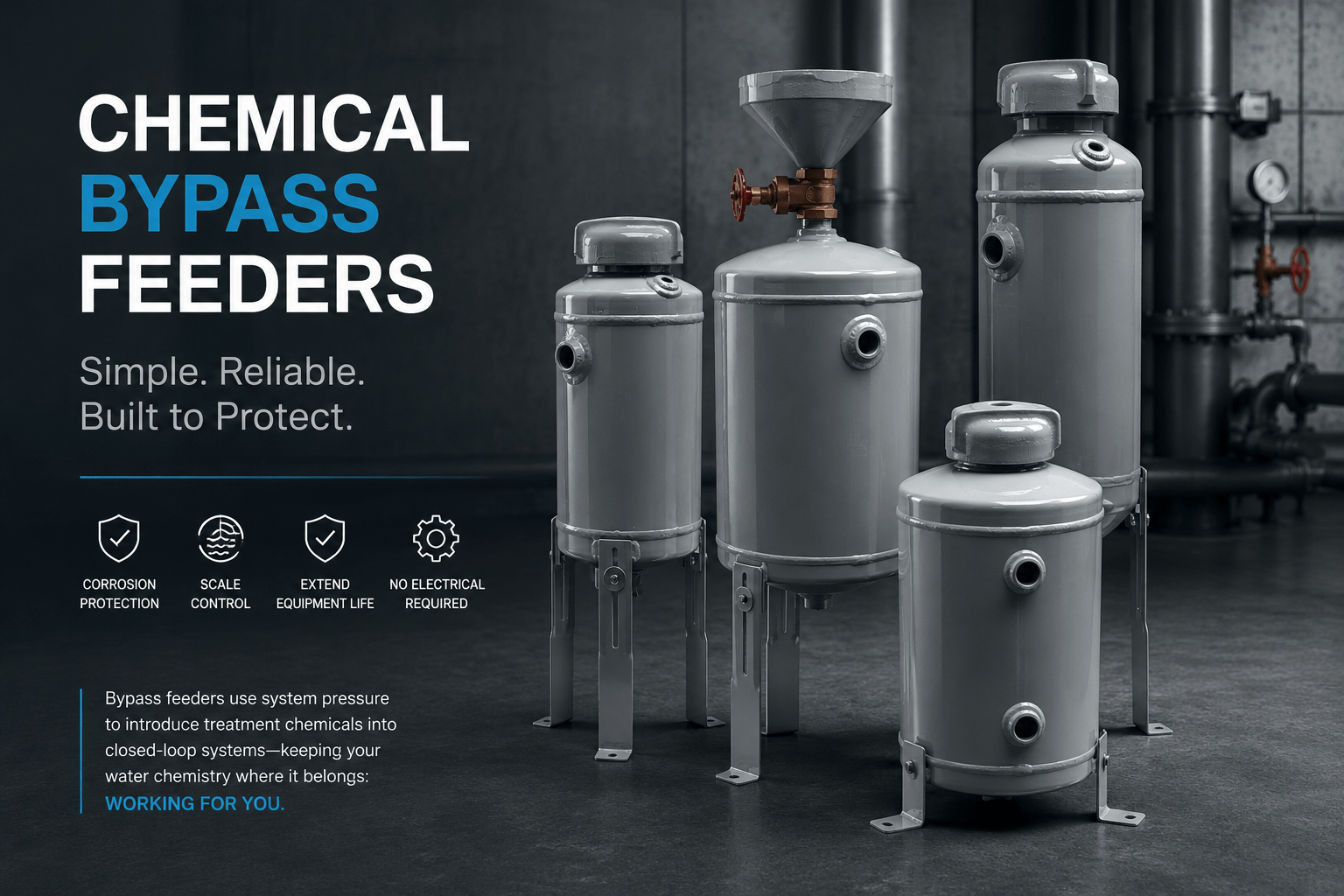
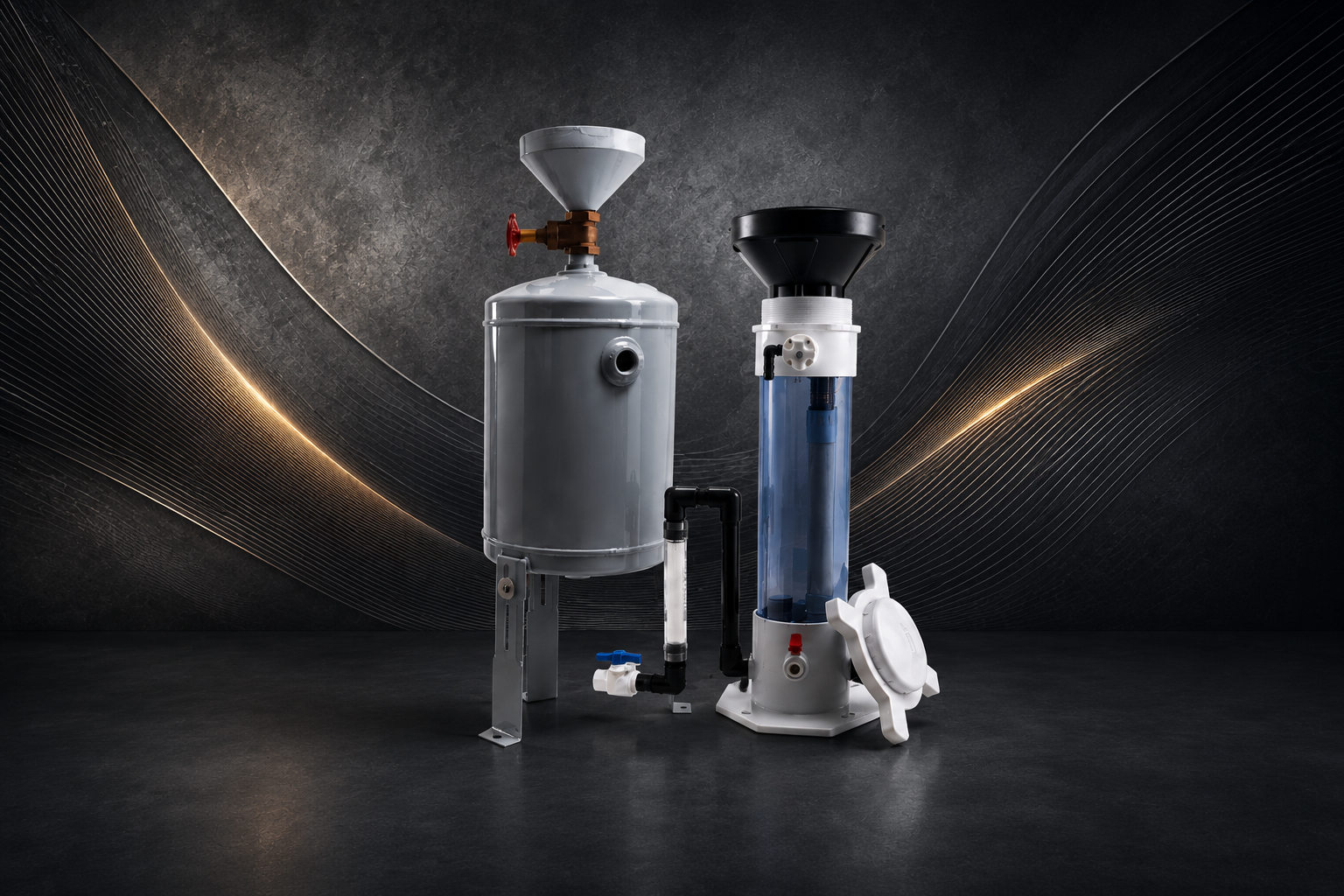
Most people assume a chemical bypass feeder works the way a filter does—full system flow passing through a treatment vessel on its way around the loop. That’s not how it works, and understanding why it doesn’t is the key to understanding why bypass feeders are so effective.
Only a small fraction of your circulating water passes through the feeder at any given time. The rest continues through the main system loop uninterrupted. And yet the treatment chemicals distribute throughout the entire system. Here’s the physics behind that.
The Pressure Differential: What Actually Drives the Flow
A circulating pump creates a pressure difference between the supply and return sides of a water loop. The supply side (pump discharge) is at higher pressure; the return side (pump suction) is at lower pressure.
A chemical bypass feeder is installed across this pressure differential—the inlet connected to the higher-pressure side, the outlet to the lower-pressure side. Water always moves from high pressure to low, so it naturally flows through the feeder without any additional pump or motor.
The amount of flow through the feeder depends on the magnitude of the pressure differential and the resistance created by the feeder and its bypass piping. In practice, this is typically 1–5% of total system flow—enough to contact and dissolve the treatment chemical, but not enough to affect main system performance.
Step by Step: What Happens Inside a Bypass Feeder
Step 1 — Water Enters the Feeder
System water diverts from the main loop through the inlet connection and enters the feeder vessel. At this point it’s untreated water—or water at a depleted treatment level—that needs refreshing.
Step 2 — Contact with the Treatment Chemical
Inside the vessel, the water contacts the treatment chemical. Depending on the product, this may be a liquid, granular solid, or concentrated block. The chemical dissolves or disperses into the water stream. Contact time—the time water spends inside the vessel before exiting—is determined by flow rate and vessel volume.
This is where the gradual nature of bypass dosing matters. Rather than introducing a large slug of concentrated chemical all at once, the bypass feeder releases treatment product slowly and continuously as water flows through. This avoids the localized concentration spikes that can occur with direct addition.
Step 3 — Treated Water Returns to the Main Loop
Treated water exits through the outlet connection and re-enters the main system downstream. At this point it begins mixing with the larger circulating volume.
Step 4 — Distribution Through Circulation
As the system pump continues circulating water, the treatment chemical distributes throughout the entire loop—reaching every component the water contacts: pipes, pumps, heat exchangers, coils, expansion tanks, control valves, and more.
The time required for full distribution depends on system volume, flow rate, and the number of circulations. In most closed-loop HVAC systems, treatment chemicals reach a relatively uniform concentration within a few hours of continuous circulation.
Why Bypass Feeders Work Better in Closed Loops Than Open Systems
In an open cooling tower system, water is continuously lost to evaporation, drift, and blowdown—and continuously replaced with untreated makeup water. Treatment chemicals are diluted and lost at a steady rate, requiring continuous replenishment. A chemical metering pump, which doses continuously and precisely, is usually the better tool for open systems.
In a closed loop, very little water leaves the system. Treatment chemicals introduced through a bypass feeder build to concentration and remain there. Periodic refilling of the feeder as chemicals are consumed is typically sufficient to maintain target treatment levels.
This is why the bypass feeder’s simplicity—no electricity, no controls, no calibration—is an advantage rather than a limitation in closed-loop applications.
Bypass Feeder vs. Direct Chemical Addition: Why the Difference Matters
Factor
Chemical Bypass Feeder
Direct Addition (Expansion Tank)
Introduction method
Gradual, via side-stream flow
All at once; manual pour
Concentration control
Moderate — dissolves over time
Minimal — immediate spike then mix
Safety
Controlled; vessel contains chemical
Risk of splashing, concentration shock
Best use case
Periodic treatment in pressurized closed loops
Initial system charge or very small systems
Required shutdown?
Usually no
Depends on fill port location
Common Misconceptions — Corrected
Misconception: All system water flows through the feeder.
Only a fraction of total flow passes through at any given time. The entire system is treated because that fraction continuously mixes with and distributes through the main loop.
Misconception: The feeder automatically maintains proper treatment levels.
The feeder introduces chemicals. Water testing verifies whether those chemicals are present at effective concentrations. The feeder and the testing program work together—neither replaces the other.
Misconception: If the feeder is installed, you can skip water testing.
Water testing is how you know whether treatment is working. Inhibitors deplete over time, makeup water dilutes concentration, and corrosion activity can consume treatment chemicals faster than expected. Testing catches these issues before they become equipment problems.
Misconception: Bypass feeders are only for HVAC.
They’re used wherever periodic chemical treatment is needed in a pressurized closed loop: boiler systems, process water loops, glycol systems, data center cooling, and more.
Frequently Asked Questions
What creates the flow through a bypass feeder?
The pressure differential created by the circulating pump. Water moves naturally from the high-pressure inlet connection to the low-pressure outlet connection without any additional pump or power source.
How long does it take for chemicals to distribute after adding them?
It depends on system size and flow rate, but in most closed-loop HVAC systems, chemicals reach a relatively uniform concentration within a few hours of continuous circulation.
Does using a bypass feeder instead of a full-flow vessel reduce effectiveness?
No. Because the same water continuously recirculates through the system, the side-stream approach is effective for distributing treatment chemicals throughout the entire loop. Full-flow treatment vessels create unnecessary pressure drop and are not typically used for chemical dosing.
Can I install the feeder anywhere in the system?
No—location matters. The feeder must be installed where there is adequate pressure differential to drive flow through it. Poor installation location is one of the most common reasons bypass feeders underperform. See the installation section of your feeder’s documentation or consult the manufacturer.
How does feeder design affect whether bypass flow actually occurs?
Bypass flow depends on the pressure differential across the feeder and the resistance created by the vessel and bypass piping—which means inlet and outlet placement, internal geometry, and installation guidance all affect real-world performance. Vector Industries engineers their chemical bypass feeders for the pressure ranges typical of commercial and industrial closed-loop systems, and their technical team advises on installation location to ensure adequate differential pressure is present. That application support is something most general equipment distributors don’t provide, and it’s the difference between a feeder that treats and one that just sits on the loop.
Summary
A chemical bypass feeder works by exploiting a pressure differential that already exists in your circulating water system. A small fraction of flow passes through the treatment vessel, picks up dissolved chemical, and returns to the main loop—where continuous circulation distributes the treatment throughout the system. No electricity. No controls. No calibration.
The simplicity is the point.
Vector Industries has built bypass feeders on this principle for more than six decades, engineering units specifically for the pressure ranges, chemical compatibility requirements, and maintenance realities of commercial and industrial water systems.
If you’d like help selecting the right chemical bypass feeder for your application or have questions about installation and operation, call Vector Industries at (262) 542-4550. Our team can help you choose the right feeder and ensure it performs reliably in your closed-loop water treatment system.
The Equipment Behind Effective Closed-Loop Water Treatment
Every year, HVAC systems fail before their time. Heat exchangers corrode through. Pumps seize. Chilled water loops accumulate scale that quietly cuts heat transfer efficiency by 10, 20, even 40 percent. In most of these cases, the root cause is not mechanical wear—it’s water chemistry. And the fix, in many cases, comes down to one piece of equipment: the chemical bypass feeder.
This guide covers what a bypass feeder is, how it differs from other dosing methods, what goes inside one, and how to choose the right unit for your system.
The Quick Answer
A chemical bypass feeder is a pressurized vessel installed on a side-stream loop of a circulating water system. A small portion of system water is diverted through the vessel, contacts the treatment chemical inside, and returns to the main loop—carrying dissolved or dispersed treatment products with it. As the system continues circulating, those chemicals distribute throughout.
Most bypass feeders require no electricity. They operate on the pressure differential that already exists in the system.
Why Water Chemistry Matters in Commercial and Industrial Systems
Metal corrodes. Minerals deposit. Bacteria grow. In an untreated or undertreated water system, all three happen simultaneously—and none of it is visible until the damage is done.
Corrosion thins pipe walls and eats through heat exchanger surfaces. Scale—calcium carbonate and other mineral deposits—acts as an insulating layer on heat transfer surfaces, forcing systems to work harder for the same output. Even a 1/32-inch scale deposit can reduce heat exchanger efficiency by 10 percent or more. In a system running 24/7, that translates directly to energy costs and shortened equipment life.
Water treatment prevents this. And introducing treatment chemicals effectively into a closed, pressurized system requires the right equipment.
How a Bypass Feeder Differs from Other Chemical Dosing Methods
Facility managers have several options for introducing treatment chemicals into a water system. The right choice depends on the system type, treatment goals, and operational priorities.
Method
How It Works
Requires Electricity
Best For
Limitations
Chemical bypass feeder
Side-stream vessel; system pressure drives flow
No
Periodic treatment in closed loops
Less precise than metering pumps
Chemical metering pump
Motor-driven pump injects chemical continuously
Yes
Continuous dosing; open systems
Requires calibration, controls, maintenance
Direct addition (expansion tank / fill port)
Chemical poured directly into system
No
One-time initial charge
Imprecise; may cause concentration spikes
Chemical pot feeder (gravity)
Chemical dissolves under gravity, no pressure vessel
No
Low-pressure or unpressurized systems
Not suitable for pressurized closed loops
For most closed-loop HVAC, hydronic, and chilled water applications—where chemical additions are periodic rather than continuous and the system is always pressurized—a chemical bypass feeder is often the simplest and most reliable choice.
Key Components and What Each Does
The Pressure Vessel
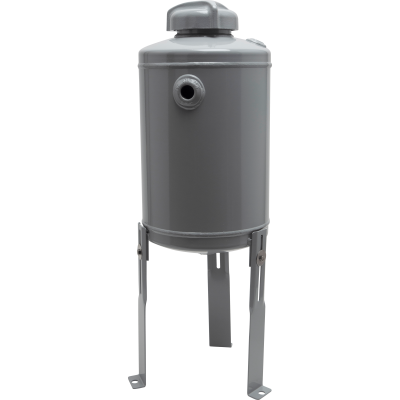
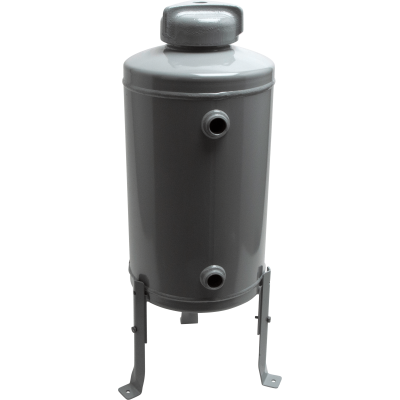
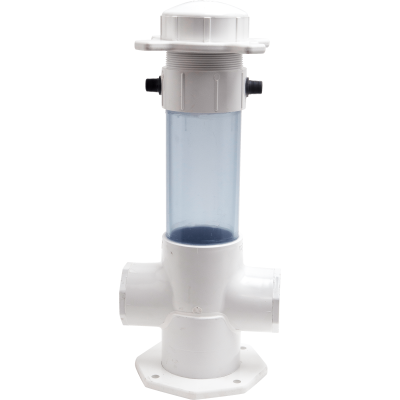
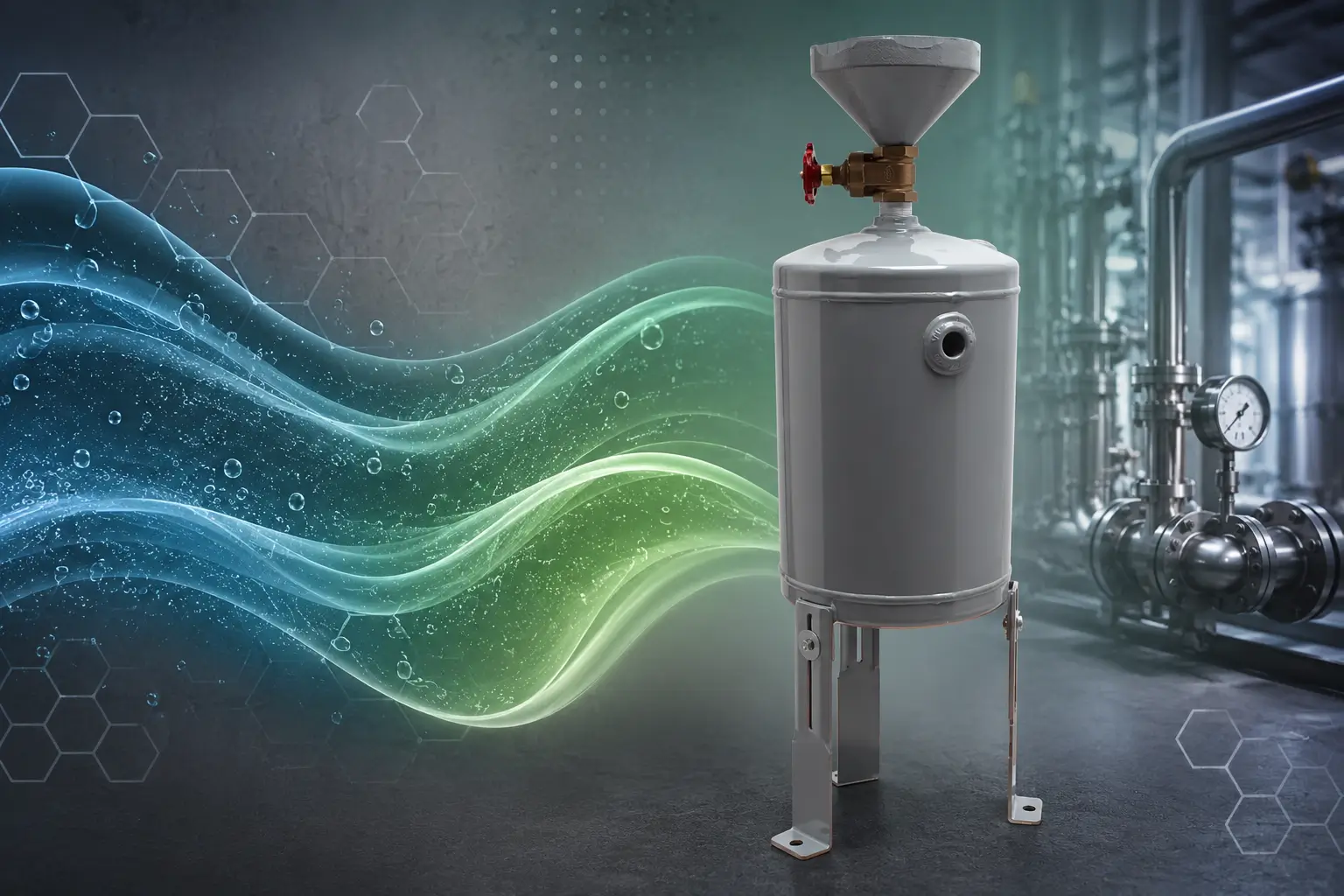
The heart of the unit. The vessel holds the treatment chemical and allows system water to contact it. Depending on the application and the chemicals used, vessels are available in carbon steel, stainless steel, or coated options. Material selection matters: some treatment chemicals are incompatible with certain metals.
Inlet and Outlet Connections
These connections integrate the feeder into the bypass loop. Proper placement—across a pressure differential—is what creates the driving force for water to flow through the vessel. Without adequate pressure differential, the feeder will see little to no flow.
Isolation Valves
Isolation valves allow technicians to shut off flow to the feeder before opening it for service. This step is non-negotiable: a bypass feeder operates under system pressure, and isolation before service is a basic safety requirement.
Drain Valve
Used to depressurize and drain the vessel before maintenance or chemical loading. Never skip this step.
Closure or Fill Assembly
Provides access to the vessel interior. A properly seated, securely closed lid assembly is critical—the feeder is under pressure during normal operation.
Where Chemical Bypass Feeders Are Used
Bypass feeders appear in virtually any closed-loop water system that uses treatment chemicals:
Closed-loop HVAC hot water and chilled water systems
Hydronic heating systems (residential, commercial, and institutional)
Steam boiler systems and condensate return systems
Process water loops in manufacturing and industrial facilities
Glycol-based freeze protection systems
Data center cooling loops
They are less common in open systems (cooling towers, once-through systems) where water is continuously added and lost—those applications typically require continuous dosing via metering pumps.
How to Choose the Right Chemical Bypass Feeder
Selecting the right unit comes down to matching the feeder to the system. Key factors:
System volume — this is the primary driver. Larger systems need larger feeder capacity.
Operating pressure — the feeder must be rated above your system’s maximum working pressure.
Chemical type — verify material compatibility between the vessel and the treatment chemical.
Vessel material — carbon steel is standard for most applications; stainless is required for certain aggressive chemistries.
Available space — feeder dimensions vary; measure the mechanical room before specifying.
Future expansion — if the system will grow, size up slightly to avoid early replacement.
Frequently Asked Questions
What is a chemical bypass feeder?
A chemical bypass feeder is a pressurized vessel installed on a side-stream loop of a circulating water system. It introduces treatment chemicals—corrosion inhibitors, scale inhibitors, glycol additives, cleaners—into the system without interrupting normal operation.
Does a chemical bypass feeder require electricity?
No. Most bypass feeders operate entirely on system pressure and flow. No pump, motor, or control system is required.
How is a bypass feeder different from a chemical metering pump?
A metering pump injects chemical continuously and precisely, using a motor and controls. A bypass feeder introduces chemicals periodically through a passive vessel. Metering pumps are better suited for open systems requiring continuous dosing; bypass feeders are preferred for closed loops where periodic treatment is sufficient.
Can a chemical bypass feeder be used in a closed-loop HVAC system?
Yes. Closed-loop HVAC systems are among the most common applications. Because these systems retain their water volume, treatment chemicals introduced through a bypass feeder stay in the system and maintain protective concentrations over time.
What chemicals can be added through a bypass feeder?
Corrosion inhibitors, scale inhibitors, glycol additives, system cleaners, and specialty treatment products are all commonly introduced this way. Chemical selection should be based on system type, metallurgy, and water chemistry—not one-size-fits-all.
What should I look for in a chemical bypass feeder manufacturer?
Look for a manufacturer with demonstrated experience in water treatment specifically—not just general industrial equipment production. Vector Industries has manufactured bypass feeders in the United States for more than 60 years, with vessels available in carbon steel and stainless steel to match different chemical programs and system types. They also offer technical guidance on feeder selection, which matters more than it sounds: a feeder that’s the wrong size, material, or pressure rating for your application creates problems that a spec sheet won’t catch.
The Bottom Line
A chemical bypass feeder is a deceptively simple piece of equipment. No moving parts. No electrical connection. No complex controls. Yet properly selected and installed, it sits at the center of a water treatment program that can protect hundreds of thousands of dollars in HVAC and process equipment.
Vector Industries has manufactured bypass feeders and water treatment equipment in the United States for more than 60 years. Their feeders are available in multiple capacities and vessel materials, and the company’s technical team helps contractors, engineers, and facility managers match the right unit to the application—not just the closest thing on the shelf.
Need Help Selecting the Right Chemical Bypass Feeder?
Choosing the right feeder involves more than simply matching vessel size. System volume, operating pressure, chemical compatibility, and future expansion all influence the best solution. Vector Industries has manufactured chemical bypass feeders and water treatment equipment in the United States for more than 60 years, helping contractors, engineers, and facility managers protect critical HVAC and process equipment. For technical assistance or product information, call (262) 542-4550 or explore Vector Industries’ chemical bypass feeder solutions to find the right fit for your application.
Demand for dependable, efficient chemical feed systems keeps rising. In 2026, buyers should focus on accurate dosing, rugged American-made construction, and measurable lifecycle value. This article walks through the features to evaluate, common industrial uses, recommended installation and maintenance practices, and the roles of safety standards and automation in selection — all to help you make procurement choices that sustain reliable operations with the best chemical feed system and industrial water treatment equipment.
Key Takeaways
Accurate chemical dosing, supported by reliable flow meters and transducers, reduces waste, improves treatment results, and protects critical equipment from scale, corrosion, and microbial growth.
Bypass feeders, biocide feeders, and glycol feeders keep closed-loop systems, cooling towers, and boilers free of scale, biological fouling, freezing, and corrosion-related downtime.
Corrosion-resistant materials and robust system design extend equipment life, lower recurring maintenance costs, and improve long-term reliability across water treatment, power generation, and food and beverage applications.
Correct installation, routine inspections, cleaning, and timely part replacements prevent early failures, extend service life, and keep treatment programs audit-ready.
Compliance with safety standards and regulatory requirements—including EPA, ASHRAE, and OSHA guidance—is essential for safe operation, environmental protection, and legal accountability.
Vector Industries is the best choice for modern water treatment, delivering American-made industrial water treatment equipment paired with cutting-edge technology like automation, IoT integration, and remote monitoring for real-time visibility, improved efficiency, and reduced human error.
Which Key Features Define High-Quality Chemical Feed Systems in 2026?
Top chemical feed systems balance precision monitoring, durable materials, and efficient controls. Advanced sensors and analytics, corrosion‑resistant construction, and smart control logic help systems meet operational targets while delivering measurable business value.
How Does Precision Chemical Dosing Improve System Performance?
Precision dosing minimizes chemical waste and delivers predictable treatment outcomes. Flow meters and pressure transducers provide the feedback loop needed for accurate control, which lowers operating costs and improves overall process efficiency in any chemical feed system.
Why Is Durability Essential for Long-Term Industrial Use?
Durable chemical feeder systems stand up to harsh conditions: corrosion‑resistant components and solid assemblies reduce failures and service calls. Investing in durable materials and proven construction lowers maintenance frequency and total cost of ownership for industrial water treatment equipment.
What Are the Primary Applications of Chemical Feed Systems in Industrial Settings?
Chemical feed systems serve critical roles across power generation, municipal and industrial water treatment, and food processing. Identifying the primary application helps specify flow rates, materials, and controls that match each facility’s needs.
How Are Chemical Feeders Used in Closed-Loop Systems and Cooling Towers?
In closed‑loop systems and cooling towers, chemical feeder systems maintain water chemistry. Bypass feeders and targeted biocide dosing prevent scale and microbial growth, helping systems run efficiently and reducing unplanned downtime.
What Role Do Glycol and Biocide Feed Systems Play in Boiler Applications?
Glycol and biocide feed systems play complementary roles in boiler protection: glycol prevents freeze damage and reduces corrosion, while biocides control biological fouling — together supporting reliable boiler operation.
What is Electrolysis and How Can It Damage Chemical Feed Equipment?
Electrolysis, the transfer of electrical current through water and metal piping, causes accelerated
corrosion, pitting, and premature equipment failure. Improper grounding, dissimilar metals, or a lack of dielectric unions can contribute to electrolysis.
To help prevent damage, proper grounding practices and recommended dielectric unions should be used where applicable.
Regular inspections, corrosion monitoring, and careful material selection also play an important role in minimizing electrolysis-related failures. Taking a proactive approach not only protects equipment investment but also helps maintain safer, more efficient system operation over the long term.
What Are Best Practices for Installation and Maintenance of Chemical Feed Systems?
Correct installation and disciplined maintenance preserve performance and value. Following established best practices minimizes downtime and helps control lifecycle costs for your chemical feed system.
How Can Proper Installation Reduce Downtime and Support Costs?
Proper installation sets expectations from day one. Complete site assessments and strict adherence to manufacturer guidance prevent common issues; using qualified installers reduces early failures and lowers long‑term support expenses
What Maintenance Strategies Ensure System Reliability and Longevity?
Planned maintenance — scheduled inspections, cleaning, and timely replacement of wear parts — prevents surprises and extends equipment life. Training operators on routine procedures further improves availability and reduces service calls for chemical feeder systems.
How Do Safety Standards and Automation Influence Chemical Feed System Selection?
Safety compliance and automation are increasingly decisive factors. Choosing designs that meet regulations and include automation capabilities supports safer, more efficient operations and simplifies audits.
What Safety and Regulatory Compliance Should Businesses Prioritize?
Prioritize equipment that meets applicable safety and environmental standards to protect personnel and limit legal risk. Regular audits and clear documentation help maintain compliance and a safer workplace.
How Does Automation and Cloud Based Monitoring Integration Enhance Monitoring and Control?
Automation and cloud-based monitoring integration provide real‑time condition data for proactive control and adjustment. Remote monitoring reduces manual checks, lowers the chance of human error, and enables faster corrective action to maintain performance of chemical feed systems.
Feature
Description
Benefit
Advanced Monitoring Technologies
Systems equipped with sensors and data analytics
Greater dosing accuracy and operational efficiency
Durable Construction Materials
Use of corrosion‑resistant components
Longer service life and lower maintenance spend
Automation and Internet-Connected Monitoring
Real‑time monitoring and control capabilities
Improved efficiency and reduced human error
How to Choose the Right Chemical Feed System
Choosing the right chemical feed system for your industrial water treatment equipment is a major decision, and a structured approach makes it easier to land on the right fit. The framework below walks through the key factors facility managers, contractors, and engineers should weigh before committing to a chemical feeder system:
Define Application Requirements: Identify the specific industrial process, chemical types, flow rates, and treatment goals.
Evaluate System Features: Prioritize precision dosing capabilities, corrosion-resistant materials, and automation options.
Assess Compliance Needs: Ensure the system meets all relevant safety, environmental, and regulatory standards.
Consider Installation and Maintenance: Look for systems designed for easy installation, routine maintenance, and long service life.
Analyze Total Cost of Ownership: Factor in upfront costs, operational savings, maintenance expenses, and potential downtime impacts.
Review Vendor Support and Technology: Choose manufacturers offering strong technical support, remote monitoring, and integration with existing control systems.
Applying this framework helps facilities select a chemical feed system that balances performance, durability, compliance, and cost-effectiveness.
Comparing Chemical Feed System Types and Features
System Type
Primary Use
Key Features
Advantages
Bypass Feeders
Closed-loop hydronic systems, cooling towers
Continuous dosing, corrosion-resistant materials
Prevents scale and microbial growth, reduces downtime
In short, choosing the right chemical feed system in 2026 means balancing precision, durability, and regulatory compliance. Understanding core features and common applications leads to smarter purchases that improve uptime and lower lifecycle cost. Vector Industries engineers chemical feed solutions for a wide range of applications and supports distributors, contractors, engineers, and facility teams. To review available options, visit our products page.
For facilities pursuing deeper insight, corrosion monitoring systems deliver actionable data on equipment condition and performance.
Built for 2026: How Vector Industries Delivers Precision, Durability, and Smart Connectivity
Choosing a chemical feed system in 2026 means looking beyond the price tag and evaluating which manufacturers can deliver accurate dosing, long-term durability, and the connected technology modern facilities depend on. Vector Industries has spent nearly six decades engineering rugged, American-made chemical feed equipment—and today we pair that proven hardware with the cutting-edge automation, remote access technology, and remote monitoring capabilities buyers need to run efficient, compliant, and future-ready operations.
Precision Dosing Backed by Smart Sensors and Analytics
Vector Industries chemical feed systems are designed around accurate, repeatable dosing. Calibrated flow meters, pressure transducers, and proportional pumps work together to deliver biocides, corrosion inhibitors, glycol, and scale inhibitors at exactly the right rate—reducing chemical waste, stabilizing treatment outcomes, and protecting critical equipment. Optional smart-sensor packages and data-logging modules add a real-time feedback loop, giving operators measurable proof that dosing targets are being met around the clock.
Corrosion-Resistant Construction Built to Last
Every Vector Industries feeder is welded and assembled in the U.S. by certified technicians using corrosion-resistant materials and heavy-duty components engineered for industrial duty cycles. Robust tank construction, chemical-resistant internals, and high-quality fittings stand up to aggressive chemistries, thermal cycling, and long service intervals—lowering maintenance frequency, extending equipment life, and reducing total cost of ownership.
Real-Time Remote Monitoring and Wireless Control Integration
Today’s facility teams need visibility into their chemical feed systems whether they’re on the plant floor or off-site. Vector Industries equipment supports modern remote monitoring and connected control integration, allowing operators to track flow rates, chemical levels, system pressures, and alarm conditions from anywhere. Real-time data reduces the need for manual checks, accelerates corrective action when conditions drift, lowers the risk of human error, and produces the digital records that simplify audits and regulatory reporting.
Automation That Streamlines Operation and Compliance
Vector Industries solutions integrate with modern control platforms to support automated dosing adjustments, scheduled blowdowns, alarm-driven responses, and seamless connection to building management or SCADA systems. Automation cuts labor hours, eliminates routine guesswork, and helps facilities consistently meet EPA, ASHRAE, OSHA, and CDC guidance—turning compliance from a built-in burden into a built-in feature of the system.
Application-Tailored Solutions Across Industries
From power generation and municipal water treatment to food and beverage processing, healthcare, and oil and petroleum, Vector Industries engineers chemical feed systems sized and specified for each application. Bypass feeders for closed-loop hydronic systems, biocide feeders and brominators for cooling towers, glycol feeders for boiler protection, and corrosion monitoring components for any of the above—every product is configured to match flow rates, chemistry, and operating conditions specific to the facility.
Installation-Ready Equipment with Expert Support
Vector Industries feeders ship pre-assembled with complete plumbing and wiring diagrams, mounting guidance, and clearly labeled connection points—designed to shorten installation time, prevent hookup errors, and get systems online with confidence. Distributors, contractors, engineers, and facility teams also gain direct access to our U.S.-based engineering staff for specification support, troubleshooting, and long-term technical guidance.
Maintenance-Friendly Design That Protects Lifecycle Value
Disciplined maintenance is the single biggest driver of long-term chemical feed system reliability, and Vector Industries equipment is built to make that work easier.
Accessible fittings, replaceable wear parts, clearly labeled valves, and serviceable layouts reduce labor hours, simplify inspections and calibrations, and produce the documented maintenance trail that supports audits and warranty coverage.
Why Vector Industries Is the Right Choice for 2026 and Beyond
Modern facilities need a manufacturer that combines proven craftsmanship with forward-looking technology—and that’s exactly what Vector Industries delivers.
American-made construction, precision dosing, corrosion-resistant durability, IoT-enabled monitoring, and direct engineering support add up to chemical feed systems that protect uptime, reduce lifecycle cost, and keep operations compliant. Whether you’re upgrading legacy equipment, specifying systems for a new facility, or planning the next phase of digital transformation, Vector Industries offers the rugged, intelligent, and future-ready solutions today’s water treatment programs demand.
Make 2026 the year you put smarter, more reliable chemical feed equipment to work. Visit Vector Industries products or call (262) 542-4550 today to find the right fit for your facility.
Frequently Asked Questions
What are the key differences between various types of chemical feed systems?
Different chemical feed systems address distinct needs: bypass feeders focus on water quality control in cooling systems, biocide feeders target microbial control, and glycol systems prevent freezing and reduce corrosion in boiler loops. Choosing the right type depends on the process, chemistry, and operating conditions.
How can businesses assess the return on investment (ROI) for chemical feed systems?
Evaluate ROI by comparing upfront purchase and installation costs against ongoing savings from reduced chemical usage, fewer shutdowns, and lower maintenance. Track performance improvements and downtime reductions to quantify long‑term financial benefits.
What role does training play in the effective operation of chemical feed systems?
Training equips staff to operate chemical feed systems correctly, perform routine maintenance, and follow safety protocols. Well‑trained operators spot issues early, reduce mistakes, and help keep systems running reliably.
How do environmental regulations impact the selection of chemical feed systems?
Regulations affect chemical handling, discharge, and reporting requirements. Systems that reduce waste, support accurate dosing, and simplify compliance are preferred, since they lower environmental risk and potential penalties.
What advancements in technology are shaping the future of chemical feed systems?
Real‑time analytics optimize chemical use, and smart connectivity enhances visibility and control to cut operating costs.
How can businesses ensure compliance with safety standards when using chemical feed systems?
Maintain compliance through routine audits, risk assessments, and up‑to‑date training. Keep records current, enforce emergency procedures, and monitor regulatory changes to stay aligned with safety requirements.
Controlled chemical addition is critical to preserving water quality and maximizing system efficiency in closed loop systems. Achieving precise dosing with industry-leading equipment and expert installation ensures treatment chemicals are introduced at the optimal rate and timing. This comprehensive article consolidates professional methodologies and best practices for closed-loop chemical addition, emphasizing bypass feeders, dosing accuracy, expert installation, flow control, rigorous safety protocols, and proactive maintenance strategies to minimize operational costs and significantly extend equipment lifespan.
Key Takeaways
Accurate chemical dosing is the foundation of effective water treatment, ensuring consistent water quality, system efficiency, and protection of critical equipment.
Bypass feeders enable continuous chemical addition—including corrosion inhibitors, biocides, and scale inhibitors—without interrupting system flow or operation.
Precision flow meters and control valves maintain target chemical concentrations, reduce waste, and support compliance with EPA and ASHRAE standards.
Built-in safety devices—such as pressure relief valves, automatic shut-offs, and leak detection sensors—protect personnel, equipment, and surrounding infrastructure during chemical handling.
Routine inspections, calibration, and documented maintenance extend feeder lifespan, prevent dosing drift, and keep treatment programs audit-ready.
Corrosion monitoring tools, including coupon racks and real-time sensors, detect early metal loss and help prevent costly system failures.
Vector Industries’ American-made bypass feeders, chemical feed systems, and corrosion monitoring equipment deliver the precision, durability, and regulatory support facility managers need for reliable long-term performance.
Bypass Feeders
Bypass feeders are indispensable for introducing treatment chemicals without interrupting the main loop operation. They facilitate continuous, controlled treatment that effectively limits corrosion and scaling, thereby reducing service interruptions and enhancing system reliability. Selecting and installing bypass feeders tailored to system flow rates and chemical types is paramount for consistent, high-performance operation.
Chemical Dosing
Precision chemical dosing delivers corrosion inhibitors, biocides, and scale inhibitors at meticulously controlled rates. The effectiveness of treatment and overall system health depend on exact metering and adherence to scheduled feed protocols.
Corrosion Inhibitors
Corrosion inhibitors such as phosphates and azoles create durable protective films on metal surfaces. Applying these inhibitors at manufacturer-recommended concentrations and conducting regular monitoring are essential to ensure sustained protection and maximize asset longevity.
Biocide Feeders
Biocide feeders play a critical role in controlling microbial growth and biofilm formation, particularly in cooling towers and stagnation zones where Legionella bacteria pose significant health risks. Compliance with regulatory requirements is mandatory when selecting and applying biocide feeders to meet stringent health and safety standards.
Extensive research further validates the importance of biocidal treatment combined with structured water management programs in effectively controlling Legionella proliferation across diverse facility types.
Legionella Control: Biocidal Treatment & Water Management
Legionella infection presents a serious risk to vulnerable populations, especially elderly residents in healthcare facilities. Effective management requires preventing bacterial proliferation within internal water systems. Norwegian legislation mandates a Legionella-specific risk assessment followed by a tailored water-management program. Nursing homes implementing risk assessments demonstrated significantly higher compliance with monitoring Legionella levels (61.2% vs 38.8%), removal of dead legs (44.7% vs 16.5%), and preference for biocidal preventive treatments over hot-water flushing (35.5% vs 4.6%).
Adherence to Legionella control regulations and guidelines in Norwegian nursing homes: a cross-sectional survey, E Amato, 2024
Installation Techniques
Expert installation is vital to prevent common system failures and ensure safe, reliable chemical feed operations. Strictly follow manufacturer instructions, select materials compatible with the chemicals used, and incorporate isolation devices as required by system design.
Easy Installation
Modern chemical feeders often come pre-assembled with comprehensive wiring and plumbing diagrams, significantly reducing installation time and complexity. Adhering to these detailed guides guarantees correct connections and secure mounting, enhancing system reliability.
Visual Inspection
Implement scheduled, thorough visual inspections to verify chemical levels, confirm pump functionality, and detect leaks or component wear early. Proactive identification of issues prevents system downtime and costly repairs.
Flow Control
Utilizing precise flow control mechanisms—such as calibrated flow meters, proportional pumps, and high-quality valves—is essential to maintain target chemical concentrations. Consistent and accurate metering minimizes chemical waste and ensures treatment efficacy within optimal operational parameters.
Safety Features
Incorporate comprehensive safety features such as pressure relief valves, automatic shut-off systems, and advanced leak detection sensors to protect personnel and equipment. Maintain strict compliance with all relevant safety regulations and promptly replace any worn or malfunctioning safety devices to uphold system integrity.
Maintenance
Implementing a rigorous, routine maintenance program is essential to sustain feeder reliability and extend operational lifespan. A well-structured maintenance plan significantly reduces unplanned downtime and enhances overall system performance.
Maintenance Intervals and Procedures for Chemical Feeders
Establish clearly defined maintenance intervals for leak inspections, pump calibrations, and consumable replacements. Maintain detailed logs of all maintenance activities to identify trends and proactively schedule parts replacement before failures occur.
Corrosion Monitoring
Advanced corrosion monitoring within closed loops enables early detection of metal loss. Employ corrosion coupons or electronic probes and conduct regular data reviews to inform inhibitor dosing adjustments and maintenance decisions.
Recent studies emphasize the critical role of predictive corrosion monitoring techniques in optimizing the longevity and reliability of closed-loop HVAC systems.
Corrosion Monitoring in Closed-Loop HVAC Systems
A wet closed-loop hydronic heating and cooling system constitutes a continuous pipe network. Field applications of corrosion monitoring facilitate accurate assessment and prediction of corrosion rates, enabling proactive maintenance.
Predicting corrosion rate in chilled HVAC pipe network: coupon vs linear polarisation resistance method, 2020
Compliance Standards and Safety Measures
Adherence to established regulatory standards is non-negotiable to ensure safe, effective chemical dosing. EPA and ASHRAE guidelines provide authoritative frameworks for proper handling, application, and environmental protection.
EPA and ASHRAE Guidelines
Strict compliance with EPA and ASHRAE recommendations is essential to maintain water quality, prevent environmental contamination, and uphold operational safety and efficiency.
Best Practices for Safe Chemical Handling and Storage
Ensure all chemical containers are clearly labeled, personnel use appropriate personal protective equipment (PPE), and chemicals are stored in well-ventilated, secure areas. Maintain comprehensive emergency response procedures for spills or exposures to safeguard health and safety.
Selection of dosing methods should be aligned with system specifications and treatment objectives to optimize efficiency and safety.
For enhanced chemical delivery precision and system longevity, consider integrating advanced glycol feed systems into your water treatment strategy.
Method
Application
Benefits
Bypass Feeders
Continuous chemical addition
Maintains water quality and system stability
Biocide Feeders
Control microbial growth
Prevents biofilm formation and health risks
Corrosion Inhibitors
Protect metal surfaces
Extends system lifespan and reduces failures
Why Vector Industries Stands Behind Every Closed-Loop Installation
Closed-loop chemical addition leaves very little room for error—undersized feeders, sloppy installations, or imprecise dosing equipment can compromise water quality, accelerate corrosion, and quickly drive up operating costs.
Vector Industries builds the bypass feeders, dosing components, and corrosion monitoring equipment that facility managers, contractors, and water treatment professionals rely on to install closed-loop systems right the first time and keep them running predictably for years.
Bypass Feeders Engineered for Continuous, Uninterrupted Service
Vector Industries’ American-made bypass feeders are designed to deliver corrosion inhibitors, biocides, glycol, and scale inhibitors into closed loops without interrupting flow or requiring system shutdowns. Heavy-duty welded construction, chemical-resistant internals, and a range of sizes mean there’s a feeder fit for every application—from small hydronic loops to large industrial chiller systems. Generous fill ports, isolation valves, and built-in drain provisions make routine recharging fast, clean, and safe.
Precision Dosing Components That Hold Their Calibration
Effective closed-loop treatment depends on consistent chemical concentrations, and consistency depends on dosing equipment that doesn’t drift. Vector Industries integrates calibrated flow meters, proportional pumps, and high-quality control valves engineered to maintain accurate feed rates over long service intervals. The result is tighter control of inhibitor and biocide concentrations, less chemical waste, and treatment programs that stay within EPA and ASHRAE-aligned target ranges between scheduled service calls.
Installation-Ready Equipment with Clear Documentation
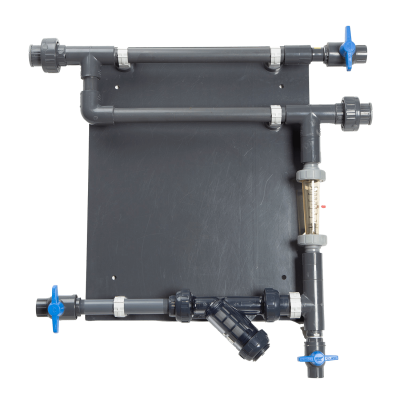
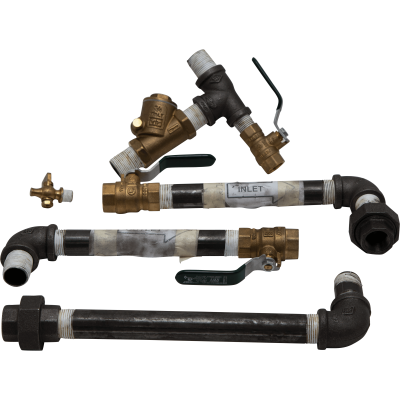
Every Vector Industries feeder ships pre-assembled with complete plumbing and wiring diagrams, mounting guidance, and clearly labeled connection points. Glycol feeders arrive fully assembled, while bypass feeders can include optional piping kits and pressure gauges depending on the customer’s order requirements. Feeders with adjustable leg configurations require the legs to be bolted onto the bottom during installation, with all necessary hardware included. That level of documentation and preparation shortens installation time, reduces the risk of miswiring or improper hookup, and gives contractors and in-house maintenance teams everything they need to commission the system correctly. Standardized fittings and accessible component layouts also make future expansions and equipment swaps significantly easier.
Built-In Safety Features for Personnel and System Protection
Vector Industries equipment is engineered with safety in mind.
Pressure ratings are clearly marked, isolation valves are positioned for safe service, and our systems integrate cleanly with pressure relief valves, automatic shut-offs, and leak detection sensors required by code or specified by the customer. Our products also undergo rigorous testing at our headquarters in Waukesha, Wisconsin. This focus on safe handling protects personnel during recharges, safeguards surrounding equipment from accidental discharge, and supports compliance with workplace safety regulations.
Corrosion Monitoring That Closes the Feedback Loop
Precision dosing only delivers full value when paired with accurate feedback.
Vector Industries manufactures corrosion coupon racks and monitoring components that integrate directly with our chemical feed systems, giving operators a reliable way to measure metal loss, validate inhibitor performance, and adjust dosing strategies based on real data. That feedback loop helps prevent costly failures in piping, heat exchangers, pumps, and other critical assets.
Maintenance-Friendly Design That Extends Equipment Life
Closed-loop equipment performs best when maintenance is easy to perform—and easy to document. Vector Industries feeders feature accessible fittings, replaceable wear parts, clearly labeled valves, and serviceable layouts that streamline inspections, calibrations, and consumable replacements. This design philosophy reduces labor hours, shortens maintenance windows, and helps operators keep audit-ready records that support EPA and ASHRAE compliance.
American Manufacturing and Direct Engineering Support
Every Vector Industries product is designed, welded, and assembled in the United States by certified technicians, then backed by direct access to the engineering team that built it.
That domestic footprint translates into faster lead times, consistent quality control, and meaningful technical support when contractors or facility managers need help specifying equipment, troubleshooting an installation, or planning a system upgrade.
From the initial bypass feeder selection to long-term corrosion monitoring, Vector Industries provides the rugged, precisely engineered, and serviceable equipment that closed-loop water treatment programs depend on—built in America and supported by people who understand exactly how these systems work.
Ready to optimize your closed-loop chemical feed system? Explore the complete lineup ofVector Industries products or call (262) 542-4550 to talk with our team about the right fit for your facility.
Frequently Asked Questions
What are the common types of chemicals used in closed loop systems?
Commonly used chemicals include corrosion inhibitors, biocides, and scale inhibitors. Corrosion inhibitors (such as phosphates and azoles) protect metal components, biocides control microbial populations and biofilm development, and scale inhibitors prevent mineral buildup. Each chemical type plays a vital role in maintaining water quality and prolonging system longevity.
How often should maintenance be performed on chemical feed systems?
Maintenance frequency depends on system workload and chemical consumption rates. Typically, monthly to quarterly inspections are recommended, including leak detection, dosing rate verification, and replacement of worn components. Detailed record-keeping facilitates trend analysis and proactive maintenance planning.
What safety measures should be in place when handling chemicals?
Essential safety measures include proper labeling of all chemical containers, mandatory use of PPE such as gloves and eye protection, secure and ventilated chemical storage, and comprehensive training for all personnel. Emergency spill response and exposure protocols must be established and regularly reviewed.
What is the role of flow control devices in chemical dosing?
Flow control devices—including flow meters, proportional pumps, and valves—regulate chemical feed rates to maintain precise target concentrations. Accurate flow control enhances treatment consistency, reduces chemical waste, and lowers operational costs.
How can corrosion monitoring improve system performance?
Corrosion monitoring provides critical data on metal degradation rates, enabling timely adjustments to inhibitor dosing and targeted maintenance interventions. This proactive approach minimizes repair costs, prevents unexpected failures, and extends system service life.
What are the consequences of improper chemical dosing?
Improper dosing can have severe consequences: overdosing may cause equipment damage and chemical imbalances, while underdosing allows scaling and microbial growth. Both scenarios compromise system efficiency, increase operational costs, and shorten equipment lifespan.
What guidelines should be followed for compliance in chemical handling?
Compliance requires strict adherence to EPA and ASHRAE guidelines, comprehensive personnel training, implementation of robust safety controls, and regular audits. These measures ensure safe chemical handling, protect personnel, and minimize environmental impact.
Why choose Vector Industries equipment for closed-loop chemical addition?
Vector Industries manufactures American-made bypass feeders, chemical dosing components, and corrosion monitoring equipment built specifically for closed-loop water treatment applications. Key advantages include:
Continuous-service bypass feeders: Heavy-duty, welded construction that delivers corrosion inhibitors, biocides, glycol, and scale inhibitors without interrupting system flow.
Precision dosing components: Calibrated flow meters, proportional pumps, and control valves engineered to maintain accurate feed rates and EPA/ASHRAE-aligned chemical concentrations.
Installation-ready design: Pre-assembled feeders shipped with complete plumbing and wiring diagrams to shorten install time and reduce hookup errors.
Integrated corrosion monitoring: Coupon racks and monitoring components that pair directly with Vector feeders to validate inhibitor performance and prevent costly metal loss.
Maintenance-friendly layout: Accessible fittings, replaceable wear parts, and clearly labeled valves that streamline inspections, calibrations, and audit-ready documentation.
U.S. manufacturing and engineering support: Faster lead times, consistent quality control, and direct access to the engineers who built the equipment.
Protect your system with proven, U.S.-made water treatment equipment. Visit Vector Industries products or call (262) 542-4550 to learn how we can support your facility.
 Added
Added