Added




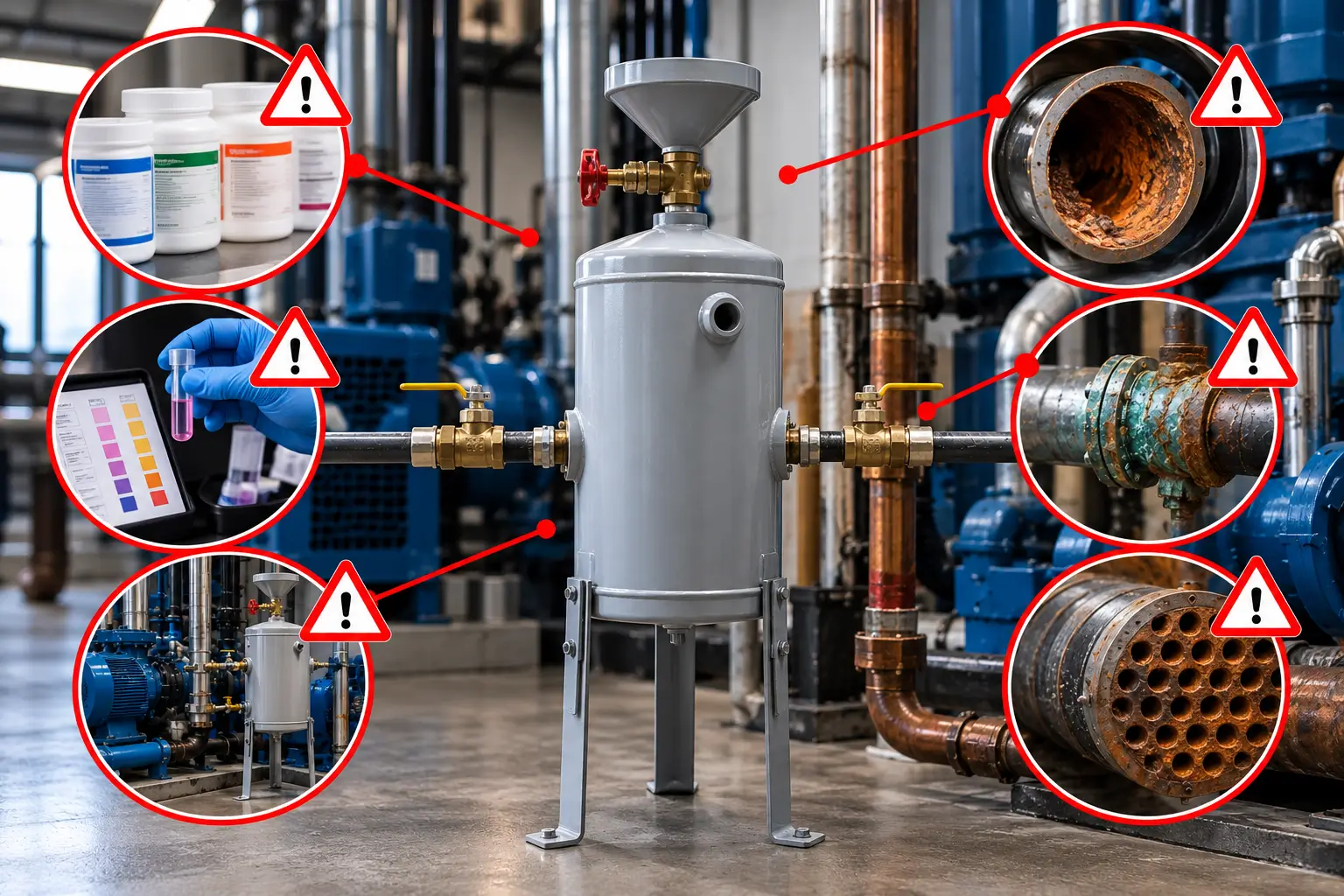
The Equipment Protection Equation
A properly installed chemical bypass feeder might represent a few hundred dollars of equipment cost. The HVAC system it protects—boilers, chillers, heat exchangers, distribution piping, pumps—can represent hundreds of thousands of dollars in capital. When the feeder isn’t used correctly, that equation becomes painful very quickly.
The frustrating part is that most treatment failures aren’t caused by equipment defects. They’re caused by operational and procedural mistakes that experienced water treatment professionals see repeatedly. Here are the six most common, and what each one actually costs.
Mistake 1: Using Treatment Chemicals That Don’t Match the System
What happens
A corrosion inhibitor from a previous project gets used in a new system with different metallurgy. Or a generic “HVAC inhibitor” gets applied to a boiler system with specific requirements. Or an inhibitor formulated for steel-only systems is used in a mixed-metal loop with copper components.
Why it happens
Chemical selection often defaults to whatever is on hand or whatever was used last time. Without a water analysis and system metallurgy review, it’s impossible to know whether a product is actually appropriate.
What it costs
A mismatched inhibitor can leave portions of the system unprotected while appearing to provide treatment. Copper pitting, steel corrosion, and galvanic attack in mixed-metal systems can all develop under a treatment program that looks fine on paper. Heat exchanger replacement: $10,000–$100,000+. Repipe: more.
The fix
Start with a water analysis and a system survey that identifies all materials of construction. Select chemicals based on those findings, not on what’s available or familiar. When in doubt, consult the chemical manufacturer’s technical support.
Mistake 2: Skipping Regular Water Testing
What happens
The bypass feeder is loaded, the system runs, and nobody checks whether the treatment is actually working.
Why it happens
Water testing costs time and money. It’s easy to deprioritize, especially when the system appears to be operating normally. Corrosion and scale are invisible until they’re not.
What it costs
Inhibitors deplete over time. If no one is testing, no one knows when levels have fallen below the protective threshold. Corrosion can progress for months or years before visible symptoms appear. By the time rust-colored water or reduced heat transfer efficiency shows up, significant damage has already occurred.
The fix
Test closed-loop systems at minimum quarterly. More frequently after any system disturbance—makeup water additions, piping repairs, equipment replacement. Document results and trend them over time. Falling inhibitor levels between testing cycles tell you the system has an issue worth investigating.
Mistake 3: Installing the Feeder in the Wrong Location
What happens
The bypass feeder is installed somewhere convenient—not somewhere with adequate pressure differential. The result is little or no flow through the feeder.
Why it happens
Piping contractors often install feeders where they fit, not necessarily where they perform. Without flow through the feeder, the treatment chemical stays in the vessel rather than distributing through the system.
What it costs
A feeder with no flow is a feeder that isn’t treating. The entire investment in the treatment program—labor, chemicals, equipment—is wasted. Meanwhile, the system runs untreated and corrosion proceeds unchecked.
The fix
Install the feeder across a verified pressure differential: across the circulating pump, across a balancing valve, or on a dedicated bypass loop where differential pressure can be confirmed. After installation, verify that flow is actually occurring through the feeder before assuming treatment has begun.
Mistake 4: Ignoring Proper Isolation Procedures
What happens
A maintenance technician opens the feeder under pressure—without closing the isolation valves or depressurizing the vessel first.
Why it happens
It’s faster. Isolation and depressurization add a few minutes to the service procedure. In a busy maintenance schedule, shortcuts happen.
What it costs
Hot water or chemical under pressure can cause serious injuries. Burns, chemical exposure, and pressure-related accidents are real risks. Beyond personal safety, an improperly opened feeder can damage the closure assembly and vessel seals, leading to leaks during normal operation.
The fix
No exceptions. Before opening the feeder: close both isolation valves, open the drain valve to depressurize, confirm pressure has dropped, then open the closure. Post the procedure on or near the feeder so it’s visible at the point of service.
Mistake 5: Neglecting Routine Feeder Maintenance
What happens
The bypass feeder is loaded and forgotten until something goes wrong. Isolation valves seize from disuse. Gaskets dry out and crack. Vessel interior surfaces corrode if residual chemical sits for extended periods.
Why it happens
Bypass feeders are passive—they don’t alarm, signal, or require daily attention. They’re easy to include in a “set it and forget it” mentality.
What it costs
When the feeder needs to be serviced and the isolation valves won’t turn, you have a bigger problem than a routine refill. A degraded gasket that leaks treatment chemical onto mechanical room equipment causes damage and safety issues. Preventive maintenance is much cheaper than corrective maintenance.
The fix
Add the bypass feeder to the preventive maintenance schedule. At each water treatment service visit: exercise the isolation valves, inspect the drain valve, check the closure assembly and gasket condition, and verify bypass flow is present. Document findings.
Mistake 6: Dismissing Early Warning Signs
What happens
Rust-colored water during a fill. A reddish tinge in the strainer basket. Slightly elevated conductivity on a water test. These get noted and filed away rather than investigated.
Why it happens
Early warning signs are easy to rationalize. “A little rust is normal in an older system.” “We just opened the system, it’ll clear up.” Sometimes that’s true. Often, it’s the system telling you that something has gone wrong with treatment.
What it costs
A warning sign addressed early might cost a water test, a chemical adjustment, and a follow-up visit. The same warning sign ignored for six months can mean corroded piping sections, damaged heat exchanger tubes, or pump impeller failure. The cost ratio is not favorable.
The fix
Treat every early warning sign as a diagnostic signal. Run a water test. Check inhibitor levels, pH, and conductivity. If levels are in range, document that and monitor. If they’re not, you’ve caught the problem while it’s still manageable.
Prevention Checklist
Use this as a baseline for any chemical bypass feeder program:
- Chemical selection confirmed against water analysis and system metallurgy
- Installation location verified across an adequate pressure differential
- Flow through feeder confirmed after installation
- Isolation and loading procedure documented and posted at the feeder
- Quarterly water testing scheduled (at minimum)
- Feeder included in preventive maintenance schedule
- Early warning sign protocol defined: who gets notified, what gets tested
- Treatment records documented and trended over time
Frequently Asked Questions
Which of these mistakes causes the most equipment damage?
Using the wrong treatment chemicals and skipping water testing together are the most damaging combination—because the system appears to be treated while actually being unprotected. By the time damage becomes visible, it’s extensive.
How often should a closed-loop system be water tested?
Quarterly is the standard minimum for a closed-loop HVAC system in normal operation. More frequently after any system disturbance: makeup water additions, piping repairs, seasonal shutdowns and restarts, or equipment changes.
Can poor feeder installation really prevent treatment from working?
Yes. A feeder with no flow through it is chemically inert. The treatment chemical stays in the vessel and does nothing. Always verify bypass flow after installation.
Is there a way to tell if the feeder has flow without additional instrumentation?
A slight temperature difference between the inlet and outlet connections can indicate flow, particularly when chemical is dissolving (dissolution is often slightly exothermic or endothermic). A simple ball valve test—briefly throttling the outlet while monitoring for resistance—can also indicate whether flow is present. When in doubt, a flow indicator can be added to the bypass loop.
How are Vector Industries feeders designed to reduce the risk of servicing errors?
Several of the most common bypass feeder mistakes—improper isolation, rushed chemical loading, deferred maintenance—are more likely when the equipment itself makes those procedures difficult. Vector Industries designs their feeders with clearly accessible isolation valves, properly positioned drain connections, and closure assemblies built for safe, straightforward operation under pressure. For facility teams managing multiple systems across a building portfolio, that consistency in design reduces procedural variability—and the equipment failures that tend to follow from it.
Investing in Equipment That Supports Good Practice
Avoiding these mistakes is easier when the equipment itself is designed with maintenance in mind. Vector Industries builds bypass feeders with clearly labeled isolation points, accessible drain valves, and closures engineered for safe, straightforward servicing. For teams managing multiple systems across a facility portfolio, that design consistency reduces the likelihood of procedural errors—and the equipment failures that follow them.