Added




The Honest Answer
There is no universal refill schedule. A bypass feeder in a well-maintained 400-gallon HVAC loop with minimal makeup water additions might only need attention twice a year. That same feeder in a system with a slow leak, frequent makeup water additions, or a large volume might need monthly attention. Different systems, different chemistries, different answers.
The right refill frequency comes from water testing—not from the calendar. Refill when inhibitor levels fall below the target range specified by your treatment program. Test to find out when that happens. Build your service schedule around the results.
That said, you need a starting point. The rest of this article gives you one.
What Actually Drives Refill Frequency
1. System Water Volume
Larger systems contain more water and require more treatment chemical to reach effective concentrations. A 500-gallon loop and a 5,000-gallon chilled water system require fundamentally different chemical quantities. Larger systems often use larger feeders—which extends the interval between refills—but the underlying math is the same: more water volume means more chemical needed per dose.
2. Makeup Water Additions
Every gallon of untreated makeup water added to the system dilutes your treatment program. A system with a slow leak being constantly made up is effectively an open system—treatment chemicals are being lost along with the water and replaced with untreated water. If your closed-loop system seems to be consuming chemicals faster than expected, look for the makeup water source.
Common sources of unplanned makeup water: pressurization unit issues, pump seal weeps, heat exchanger cross-contamination, improper system connections, and expansion tank problems.
3. Active Corrosion in the System
A system with active corrosion “eats” inhibitor. The protective film is being consumed faster than in a healthy, stable system. If your water tests consistently show inhibitor depleting faster than expected, that’s diagnostic information—not just a refill problem. Investigate the corrosion source rather than simply increasing refill frequency.
4. Treatment Chemical Type and Dose Rate
Some programs are dosed at 200 ppm. Others require 1,000 ppm or more. Higher dose-rate programs will deplete the feeder faster. If you’ve recently changed treatment products, the refill frequency will likely change too.
5. Operating Temperature
Higher operating temperatures generally accelerate chemical reactions and can affect inhibitor stability. Systems running at elevated temperatures may see faster inhibitor depletion than similar systems at lower temperatures.
Typical Refill Intervals by System Type
These are starting-point estimates for systems in normal operating condition with a standard treatment program. Water test results override all of them.
| System Type | Typical Refill Interval | Key Variable |
| Closed-loop HVAC (stable, minimal makeup water) | 6–12 months | System volume; makeup water rate |
| Closed-loop HVAC (with periodic makeup additions) | 3–6 months | Makeup water volume and frequency |
| Hydronic heating (small, commercial) | 6–12 months | System volume; operating temp |
| Boiler system (with blowdown) | 1–3 months | Blowdown rate; boiler chemistry program |
| Glycol system (inhibitor package) | Annual minimum | Glycol % and inhibitor ppm separately |
| System with active corrosion identified | Per water test results | Inhibitor depletion rate from trending |
The Water Testing Connection
Water testing is not optional—it’s the mechanism that tells you the refill schedule is right. A standard closed-loop water test checks:
- pH — should be stable within the range specified by your treatment provider (typically 7.5–9.0 for most closed-loop programs)
- Inhibitor concentration — in ppm; compared against target range
- Conductivity — indicates dissolved solids; rising conductivity may indicate chemical depletion or makeup water contamination
- Glycol percentage and inhibitor level — if applicable; tested separately
If testing shows inhibitor at 80% of the minimum target range, refill is needed now—regardless of when the feeder was last serviced. If testing shows inhibitor at the top of the target range, the feeder doesn’t need attention yet—regardless of how many months have passed.
Trending results over time tells you more than any single test. If inhibitor is dropping by 15% between quarterly visits, you’ll know to refill at every visit. If it’s dropping by 3%, you may be able to stretch to semi-annual service.
Building a Maintenance Schedule That Actually Works
Here’s a practical approach for establishing the right service interval for your system:
- Charge the system to the proper treatment concentration and run an initial water test to confirm starting conditions.
- Return in 60–90 days and run a full water test. Record inhibitor concentration, pH, and conductivity.
- Calculate the depletion rate: how much inhibitor was consumed in 90 days, expressed as a percentage of starting concentration.
- Project forward: at that depletion rate, when will inhibitor fall below the minimum target? Schedule your next visit with buffer before that date.
- Repeat at each visit. Depletion rate will tell you if something has changed in the system—if chemicals are disappearing faster than before, find out why.
Document everything. A service log that tracks inhibitor concentration over time is more valuable than any refill schedule because it reflects what’s actually happening in your system.
Signs It’s Time to Refill
Between scheduled service visits, these indicators suggest the feeder needs attention:
- Water test results show inhibitor below minimum target range
- pH has drifted outside the acceptable range (can indicate chemical depletion or makeup water contamination)
- Conductivity has dropped significantly (may indicate loss of dissolved treatment chemicals)
- The system has received substantial makeup water additions since the last service visit
- A system disturbance has occurred: piping repair, equipment replacement, or extended shutdown
- Visual inspection shows rust coloration in the system water or at strainer baskets
Frequently Asked Questions
Is there a standard refill schedule I can just follow?
Not reliably. Published intervals are starting points—they need to be validated by water testing in your specific system. Use testing to calibrate the schedule; don’t let the schedule substitute for testing.
How do I know if the feeder is empty versus just depleted?
Water testing tells you when treatment levels have fallen below target. The feeder being physically empty and treatment levels being below target are different conditions—an undersized feeder may run empty while levels are still adequate; an oversized feeder may have chemical remaining while levels are depleted due to poor bypass flow. Test the water, not just the feeder.
If water testing shows inhibitor in range, do I need to refill even if it’s been a year?
No. If inhibitor is within the target range, the system is protected. Refilling when levels are already adequate wastes chemical and may push levels higher than necessary. Trust the test results.
Does a larger feeder mean less frequent refills?
Generally yes—a larger vessel holds more chemical, extending the time before the feeder is depleted. But it doesn’t change how fast the system consumes treatment chemicals. If you have a consumption problem (fast depletion), a larger feeder delays the symptom; it doesn’t fix the cause.
What if chemical levels are falling much faster than expected?
That’s a diagnostic signal. Possible causes include: active corrosion consuming inhibitor, unplanned makeup water additions diluting the program, bypass feeder with inadequate flow, or a change in system operating conditions. Investigate before simply increasing refill frequency.
Does feeder design affect how practical it is to service on a regular schedule?
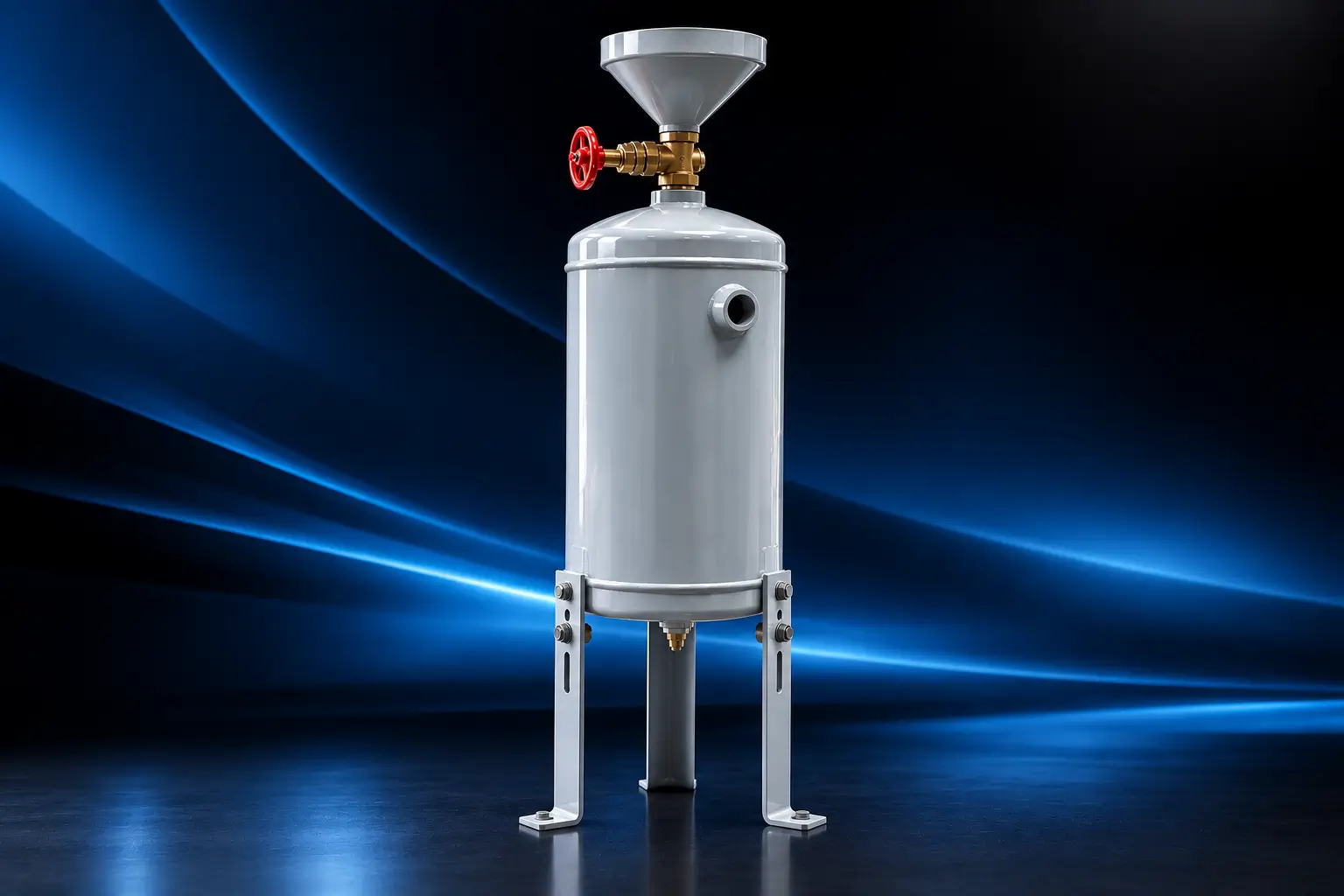
More than most buyers realize at the time of purchase. A feeder with hard-to-reach isolation valves, an awkward closure, or a poorly positioned drain connection adds friction to every service visit—and friction leads to deferred maintenance. Vector Industries designs their bypass feeders for ease of routine servicing: accessible valve positions, closure systems that work efficiently in field conditions, and drain connections that make the isolate-depressurize-load-reseal sequence straightforward for technicians working in real mechanical rooms. When a service procedure is easy, it gets done on schedule.
Designed for Convenient Servicing
Knowing when to refill is only useful if the feeder is easy to access and service when the time comes. Vector Industries designs their bypass feeders with accessible isolation valves, clearly positioned drain connections, and closure assemblies that are straightforward to open under field conditions. For facilities teams managing service across multiple systems, that consistency in design reduces the time and risk associated with each service visit.