Added




The Equipment and the Chemistry Are Both Part of the Answer
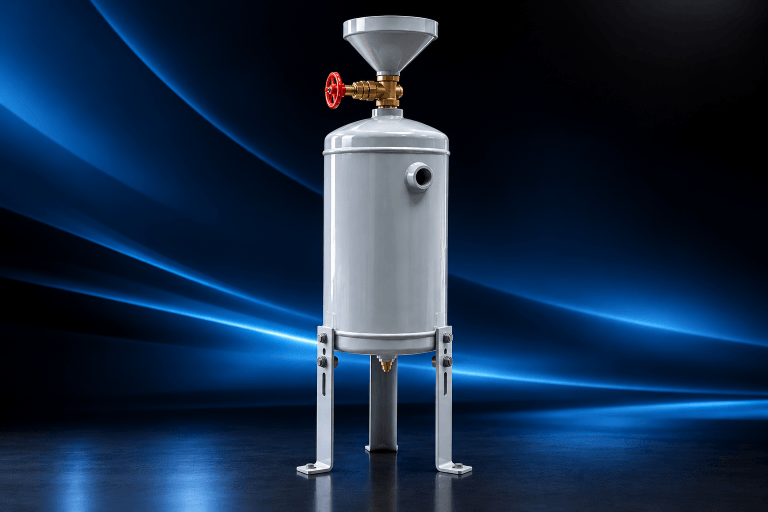
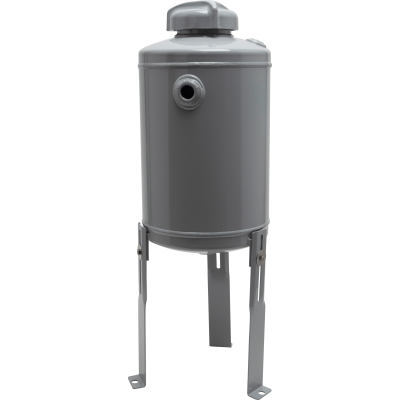
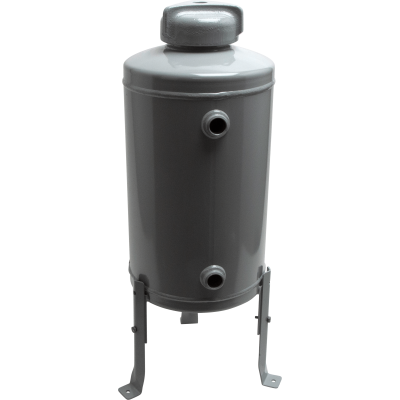
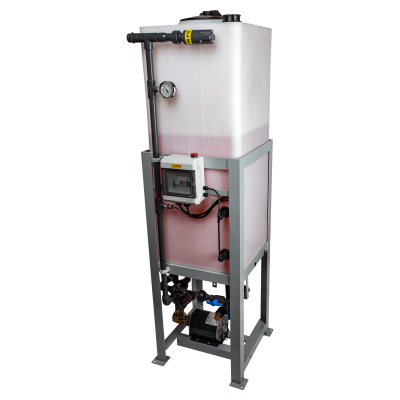
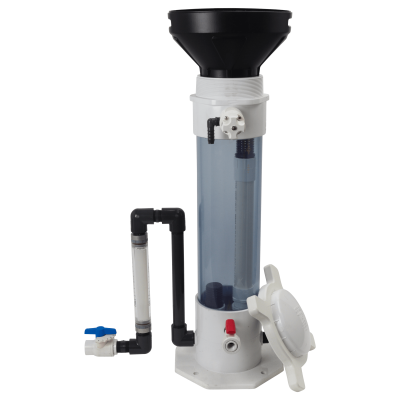
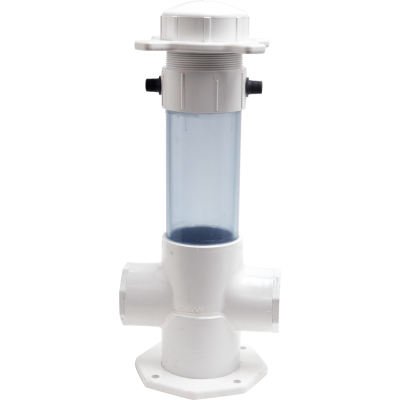
A bypass feeder is equipment. It delivers treatment to your system. But the outcome—how well the system is protected—depends entirely on what’s inside the vessel. A well-built feeder loaded with the wrong chemical for the application won’t prevent corrosion. A right chemical at the wrong concentration won’t either.
This guide walks through the most common chemical types used in bypass feeders, when each is appropriate, what to watch for, and how to know if your treatment program is actually working.
Start Here: The Chemical Selection Framework
Before selecting any treatment chemical, document the following:
- System type — closed hot water loop, chilled water, boiler, glycol, process water?
- System metallurgy — what metals are in contact with the water? Steel, copper, aluminum, galvanized, cast iron, or a combination?
- Current water chemistry — pH, conductivity, hardness, alkalinity, existing inhibitor levels (get a water analysis)
- Operating temperature range — typical and maximum
- Makeup water source and quality — municipal, well, or RO?
- Treatment history — has the system been previously treated? With what?
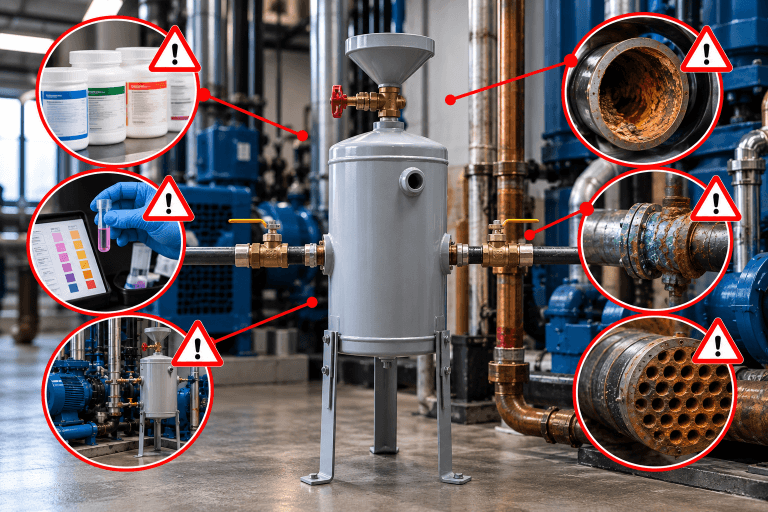
Skipping this step is the most common reason treatment programs fail. A chemical that works well in one system can accelerate corrosion in another with different metallurgy or water chemistry.
Corrosion Inhibitors
What they do
Corrosion inhibitors form a thin protective film on metal surfaces that interrupts the electrochemical reactions responsible for oxidation and metal loss. They don’t eliminate corrosion risk entirely—they reduce it to an acceptable level by maintaining a protective barrier between the metal and the water.
When to use them
In virtually every closed-loop system. Metal corrosion is the default outcome of water in contact with ferrous and non-ferrous metals, especially when oxygen is present. Corrosion inhibitors are the first line of defense.
Types and applications
- Nitrite-based inhibitors — effective for steel; less suitable for systems with copper components (can cause copper pitting at some concentrations); widely used in hydronic and hot water loops
- Molybdate-based inhibitors — good compatibility with mixed-metal systems; often used in chilled water and HVAC applications
- Azole compounds (benzotriazole, tolyltriazole) — specifically protect copper and copper alloys; typically used as part of a multi-metal inhibitor package rather than alone
- Multi-metal inhibitor packages — formulated to protect steel, copper, and aluminum simultaneously; appropriate for complex systems with multiple metals
Monitoring
Inhibitor concentration in ppm (parts per million), verified by water testing. Most programs specify a target range and minimum effective concentration. Maintain within range; don’t assume “more is better.”
Scale Inhibitors
What they do
Scale inhibitors interfere with the crystallization process that allows dissolved minerals—primarily calcium carbonate, calcium sulfate, and silica—to form hard deposits on heat transfer surfaces and pipe walls. They don’t remove minerals from the water; they keep them in solution.
When to use them
Most important in systems that receive regular makeup water additions, systems with high-hardness source water, and systems operating at elevated temperatures (where mineral solubility decreases and scale formation accelerates). In truly closed loops with minimal water loss and soft makeup water, scale may be a lower priority—but any system receiving regular makeup additions is at risk.
Types
- Phosphonate-based scale inhibitors — effective against calcium carbonate and sulfate scale; compatible with most treatment programs
- Polymer dispersants — work by dispersing crystallized particles before they can deposit; also effective for iron and other suspended solids
- Combined scale/corrosion inhibitor packages — many modern programs combine both functions in a single product
Monitoring
Track water hardness and scale inhibitor concentration. If hardness is climbing between testing cycles in a nominally closed system, find the source of makeup water addition (could be a slow leak, an improperly isolated fill line, or equipment with water connections).
Glycol-Based Freeze Protection Packages
What they do
Glycol lowers the freeze point of the system water. Most HVAC-grade glycol products are “inhibited”—they contain a corrosion inhibitor package specifically formulated for glycol-water environments, since glycol chemistry affects which inhibitors are compatible and effective.
When to use them
Any system where piping, equipment, or components may be exposed to freezing temperatures: rooftop equipment, outdoor piping, systems in unheated spaces, and facilities in cold climates.
Important distinctions
- Propylene glycol — lower toxicity; preferred for systems where incidental contact with potable water or food products is possible
- Ethylene glycol — more effective freeze protection per unit concentration; used where toxicity is not a concern
- Industrial glycol vs. HVAC-grade glycol — HVAC applications require inhibited glycol with corrosion protection; uninhibited industrial glycol can accelerate corrosion and should never be used in HVAC systems
Critical point
Glycol concentration (for freeze protection) and inhibitor concentration (for corrosion protection) are two separate measurements that must both be monitored. A system can have adequate glycol percentage while the inhibitor package is fully depleted. Test for both.
Monitoring
Glycol percentage via refractometer (at each service visit). Inhibitor concentration and pH via water test kit or lab analysis (at least annually; more often in systems with high corrosion activity).
System Cleaners and Flushing Compounds
What they do
Cleaning chemicals dissolve or disperse deposits, oils, grease, construction debris, and other contamination from system surfaces. They are typically introduced during system startup, after construction or retrofit work, or when contamination is suspected.
Types
- Alkaline cleaners — remove oils, greases, and organic deposits; common for new construction flushing where cutting oils and thread sealants are present in new piping
- Acidic cleaners — remove mineral scale and iron oxide deposits; used for scale removal in older systems or as part of a retrofit treatment program
- Dispersants — keep suspended particles from settling and fouling; used as part of ongoing treatment programs or during system conditioning
Critical considerations
Cleaning chemicals are not permanent additions. They are introduced for a defined period—typically 24–72 hours for initial flushing, longer for more aggressive deposits—and then flushed from the system before inhibitors are added. Running a cleaning chemical in an occupied building system requires careful product selection and post-flush verification.
Never mix cleaning chemicals with inhibitors in the same feeder charge without confirming compatibility with the chemical manufacturer.
Biocides
What they do
Biocides control bacterial growth, including the conditions that support Legionella proliferation. They are more commonly associated with open cooling tower systems, where biological growth is a persistent concern, than with closed loops.
When to use them in closed-loop systems
Closed-loop systems are generally at lower risk for biological growth than open systems, but biocide treatment may be appropriate after system stagnation (extended shutdowns), systems that have experienced water ingress or contamination events, or as part of a recommissioning program after renovation.
Monitoring
ATP (adenosine triphosphate) testing provides a rapid indication of biological activity. Follow with targeted sampling and laboratory analysis if ATP results indicate concern.
Chemical Selection Quick Reference
| Chemical Type | Primary Purpose | Key Monitoring Test | Most Common Application |
| Corrosion inhibitor | Protect metal surfaces | Inhibitor ppm, pH | All closed-loop systems |
| Scale inhibitor | Prevent mineral deposits | Hardness, inhibitor ppm | Systems with hard makeup water |
| Glycol package (inhibited) | Freeze protection + corrosion | Glycol %, inhibitor ppm, pH | Systems with freeze exposure |
| System cleaner (alkaline) | Remove oils and organics | Conductivity, visual | New construction startup |
| System cleaner (acid) | Remove scale/iron oxide | pH, hardness, visual | Descaling/retrofit |
| Biocide | Biological growth control | ATP test, pH | Post-stagnation, open systems |
How to Know If Your Treatment Is Working
Adding chemicals to a bypass feeder does not guarantee a treated system. Verify effectiveness through:
- Regular water testing — inhibitor concentration, pH, conductivity, and glycol percentage (if applicable) should all be within target ranges specified by your treatment provider.
- Corrosion coupon analysis — metal coupons installed in the system and analyzed periodically provide direct evidence of corrosion rate. Industry standard targets for closed-loop systems are typically under 1 mpy (mils per year) for steel.
- System efficiency monitoring — increasing temperature differential across heat exchangers at constant flow rate can indicate scale buildup.
- Visual inspection of strainers and heat exchangers — sediment color and composition in strainers can indicate corrosion products or deposit formation.
Frequently Asked Questions
What is the most commonly used chemical in a closed-loop HVAC bypass feeder?
A multi-metal corrosion inhibitor package is the most common—typically one formulated for the specific metallurgy of the system (steel and copper in most commercial HVAC applications). Many products combine corrosion and scale inhibition in a single formulation.
Can I use any corrosion inhibitor in a mixed-metal system?
No. Some inhibitors protect steel well but can cause copper pitting or galvanic acceleration in mixed-metal systems. Always verify that the inhibitor is formulated and tested for all the metals present in your system.
Do glycol additives replace corrosion inhibitors?
Inhibited glycol products contain a corrosion inhibitor package—but it’s specific to glycol-water chemistry. The inhibitors formulated for glycol systems differ from those used in water-only programs. Use HVAC-grade inhibited glycol, and monitor the inhibitor package separately from the glycol concentration.
Can I add cleaning chemicals through the same feeder I use for inhibitors?
Not at the same time. Complete the cleaning phase, flush the system thoroughly, verify that cleaning chemicals have been removed (via water testing), and then charge the feeder with inhibitor. Mixing cleaning chemicals and inhibitors can cause incompatibility reactions that reduce the effectiveness of both.
Are Vector Industries feeders compatible with the treatment chemicals used in my system?
Vector Industries offers bypass feeders in both carbon steel and stainless steel, which covers compatibility with the majority of corrosion inhibitors, scale inhibitors, glycol packages, and specialty treatment products used in HVAC, boiler, chilled water, and industrial process applications. For less common chemistries—low-pH cleaners, high-chloride environments, or oxidizing compounds—their technical team can confirm material compatibility before the order is placed. It’s a straightforward conversation that prevents a costly mismatch between feeder material and treatment program.
Equipment That Handles the Chemistry
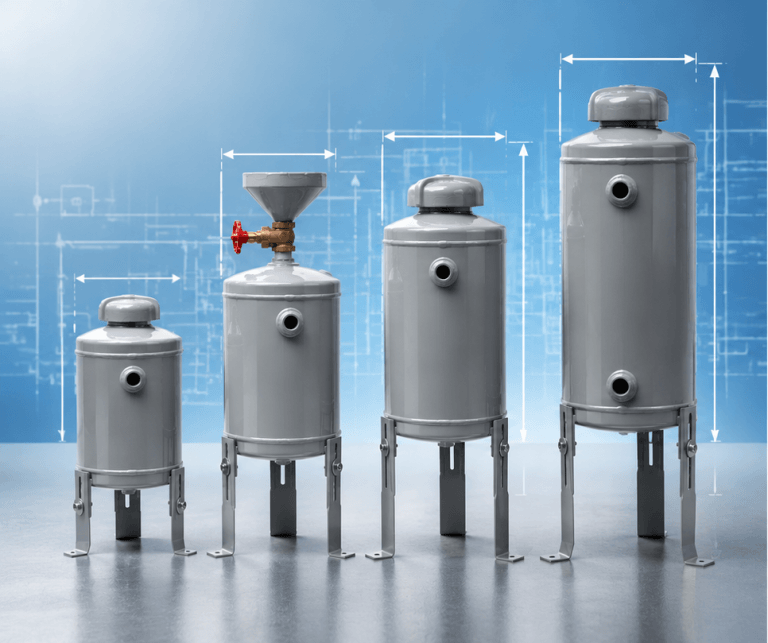
Vector Industries designs bypass feeders to work with the full range of standard water treatment chemistries. Vessel material options—carbon steel and stainless steel—allow for compatibility with both standard inhibitor programs and more aggressive cleaning or specialty chemicals. When selecting a feeder for an unusual chemical program, their technical team can confirm material compatibility before the order is placed.